
Start an Ohio Resident Search
For a known name, begin with the Ohio county or court tied to the person's life event or address. Ohio has no one statewide residential-address search. A current voter result can show registration details and precinct where those fields are public. An Ohio court result belongs to a specific court layer. A county tax card links an owner to a parcel, not necessarily to a household. For an older Ohio resident, a city directory, newspaper, census schedule, cemetery index, or probate file may be a better fit.
- Choose the likely Ohio county, city, record type, and date range.
- Search the matching official portal or ask the listed custodian for its index.
- Write down the record date, person's role, and exact spelling shown.
- Check a second source that answers the same question from another angle.
- If the index stops, ask about a counter terminal, paper file, library, or archive.
A name match in Ohio records is a lead, not proof that two records describe one person. Compare dates, county, case role, parcel, or family links before joining the entries.
Where Ohio Keeps Resident Records
Ohio's record trail is divided among offices with distinct duties. The Ohio Secretary of State runs statewide election resources, the Ohio Department of Health handles birth and death administration, and the Supreme Court of Ohio links to local trial courts. For land, each Ohio county has its own Auditor or Fiscal Officer and Recorder. Probate, common pleas, municipal, and county courts also keep separate Ohio files. A result from one office cannot stand in for all the others.
Ohio's agencies do not combine those records into one name search. Choose the office by the question the record can answer.
Ohio History Connection
State Archives and local-government records guidance
Finding aids, retention, and transferred records
Ohio Department of Health
Bureau of Vital Statistics
State and local registrar routes for birth and death records
Ohio Secretary of State
VoteOhio and statewide voter resources
Individual lookup plus links to county Boards of Elections
Ohio's 88 County Record Systems
An Ohio county is the first routing choice for an Ohio property, probate matter, local court case, or broad voter-file request. There is no statewide Recorder index or owner-name property portal. The Ohio Public Records Act supplies a shared legal framework, but portal design, older coverage, copy rules, and request contacts remain local to each Ohio county.
When an Ohio online search returns nothing, the record may be held by another county or court, filed under an older place name, or available only at a counter or in an archive. Ohio History Connection's Local Government Records Program helps readers understand retention and transfers; it does not replace the Ohio office that owns an active record series.
Franklin County's property and Recorder systems are useful named Ohio examples. Their fields and map tools should not be assumed to exist in the same form in the other 87 Ohio counties.
Ohio Residents Directory Search Sources
Current Ohio record tools describe different roles rather than a complete list of household members. An Ohio county Auditor tracks tax parcels, a Recorder indexes land instruments, a Board of Elections maintains voter registration, and local courts publish selected dockets. Read each Ohio result as of its own date and under the field name the custodian uses.
| Record source | What the entry means | Ohio custodian | Access route |
|---|---|---|---|
| County property card | Tax owner, parcel, situs, and mailing fields | County Auditor or Fiscal Officer | County portal, counter, or map |
| Voter Lookup | Registration status, county, precinct, and public fields shown | Ohio Secretary of State and county boards | Individual lookup; broader files follow separate rules |
| Recorder index | Named parties to a recorded land instrument | County Recorder | County index, terminal, copy request, or counter |
| Court docket | A party's role in a case and its public events | Local clerk or Supreme Court | Portal, terminal, clerk counter, or specific request |
| Historical directory | A dated published entry tied to a place | Library, archive, OGS, or collection holder | Catalog, reading room, microfilm, or staff help |
An Ohio residents directory search works best when each entry is checked against the office and date that produced it. Use an Ohio voter record to check registration, a deed to trace a land transfer, and a court docket to follow a case. None alone is a statewide roster of current residents. When the question narrows to one person, the Ohio resident lookup path shows how to compare records without treating a tax address as proof of occupancy.
Government indexes and commercial people-finder services have different strengths and limits:
| Source type | Useful for | Limits to keep in view |
|---|---|---|
| Ohio government record | Checking a dated entry with the office that created or keeps it | County, court, and record type set the scope; exemptions and redactions apply |
| Commercial people-finder category | Locating a possible lead across compiled sources | Sources, freshness, cost, and correction routes vary; verify a result with its custodian |
Franklin Property Records Start at the Auditor
Franklin County's Auditor property search is one Ohio county example, not an Ohio-wide owner search. Its parcel record can connect a situs address with a tax owner, mailing address, legal description, value, district, and transfer clues where shown. Those Ohio field labels are not interchangeable: situs means the physical parcel, while the tax mailing line is where notices go. Neither one establishes who occupies a property.
The Franklin County Auditor publishes the county property-search entry point. Its Ohio results help identify a parcel before a reader checks the Recorder for the deed. The map and tax card are appraisal tools, so the recorded instrument remains the place to verify title under Ohio county records.
For a view of the county's property search route, open the Franklin County Auditor property search shown here.
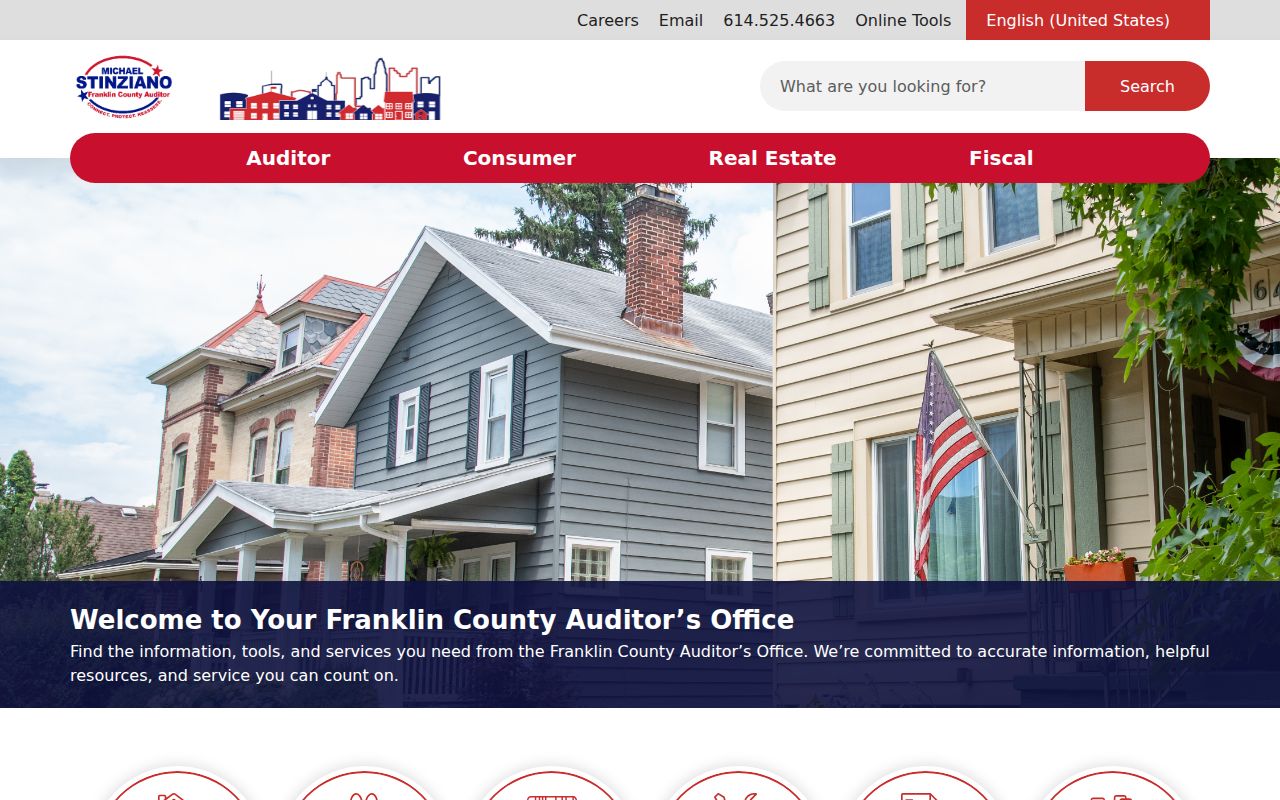
This Franklin County card is a starting point for an Ohio parcel question. Other Ohio counties maintain their own property sites and fields.
- Situs address
- The physical location of the parcel.
- Tax mailing address
- The address where property notices are sent.
- Parcel
- A unit of land identified in the county tax and mapping system.
Ohio Voter Lookup Fields
The Ohio Secretary of State's Voter Lookup is an individual registration tool, not an all-resident directory. The live Ohio form is dynamic, and the statewide research did not expose a stable set of input labels or required fields. Follow the labels and limits shown by the current service.
| Search inputs | Dynamic labels; exact fields and required status were not exposed in the research capture. |
|---|---|
| Possible public result | Name, residence, county, precinct, and voting-history fields may be visible; the live result controls. |
| Restricted fields | Social Security and state ID numbers, phone, email, confidential records, and protected addresses are excluded. |
| Request alternative | For a broader voter file, contact the county Board of Elections and confirm fields, snapshot, cost, and redactions. |
Ohio Revised Code §3503.13 excludes sensitive identifiers and certain protected voter records from the public database, including Social Security and driver-license numbers, phone and email fields, confidential records, and protected addresses. Use only fields the official lookup displays.
For a correction or a specific Ohio public-record question, contact the county Board of Elections. A broad Ohio voter-file request is a separate route and may have its own scope, cost, snapshot date, and redactions.
Ohio Court Searches Follow Jurisdiction
Ohio has no universal trial-court name search. The Supreme Court's county court directory helps route a reader to local Ohio courts, but it is not itself a statewide trial docket. Municipal, county, common pleas, and Probate Courts maintain separate Ohio records, and the case type determines which Ohio clerk to ask.
The Ohio Supreme Court's public docket covers Supreme Court matters, including appellate activity. An Ohio case result can show a number, caption, filing or event dates, party role, disposition, and document links, depending on the portal. The underlying trial file stays with the Ohio local court.
If an Ohio local portal leaves out an older case or image, call the clerk about its public terminal, records room, copy rules, or a specific request under Ohio's public-records law. Sealed, juvenile, adoption, victim, and protected personal information is not made open just because a docket entry appears online.
Ohio Vital Records Use Separate Custodians
Ohio birth and death records route through the Ohio Department of Health and local registrars. Marriage licenses and many estate records begin with an Ohio county Probate Court. Divorce material is generally held by the court that granted it. Ohio does not provide one statewide public marriage-record search, and a certificate order is different from an open Ohio name index.
The ODH Bureau of Vital Statistics explains current state routes. Under ORC §3705.23, issuance depends on the record and applicable exceptions. Adoption or replaced birth records and medical-only fields have special limits; a decedent's Social Security number is generally withheld for five years unless an authorized requester qualifies. Check the current ODH or local registrar form for signature, eligibility, and fee details before ordering.
Ohio libraries and archives can help locate historical evidence, but they do not issue a current certified certificate. An Ohio newspaper notice or obituary can point to an event; the Ohio registrar or court remains the source for an official copy.
Ohio Heir Searches Join Separate Records
An heir search is a good example of why Ohio records work best as a sequence. Begin with the Ohio county Probate Court's estate index for the case, will, inventory, fiduciary appointment, land sale, or notice. Then use the Ohio Recorder's deed chain to tie a property transfer to the parcel. An Ohio obituary, city directory, cemetery entry, or family history file can help connect a name variant or relative, but each source has a different date and purpose.
Ohio birth, death, and marriage records may confirm a family event when an applicant meets the current rules. Use a certificate only through ODH, an Ohio local registrar, or the Probate Court that holds it. Keep protected adoption or medical information out of an ordinary search. A family-history conclusion should name the Ohio records and dates that support it, rather than claim more than the sources show.
When an Ohio court file or land book is not online, ask the county office about a terminal, counter search, copy request, or archival transfer. The local Ohio library may also have an obituary index, newspaper reel, directory, or county history that supplies the next name or date to check.
Request Ohio Resident Records
The Ohio Public Records Act, ORC §149.43, covers records kept by an Ohio public office, subject to exemptions and redactions. A useful request names the office and existing record series, then narrows the person, address or parcel, time span, and preferred format. Ohio law does not require an office to create a new report or answer a research question.
A requester generally need not give a name or reason for an ordinary Ohio request. If a description is unclear, the office should explain how records are kept and allow a chance to revise it. Ask for non-exempt parts and the legal basis for a redaction. Prompt access is required, but there is no universal fixed number of days for every Ohio request; large or complex searches depend on their scope and circumstances.
Online index first, then an Ohio public terminal or records counter, then a specific written request, then the library or archive for older material. The Ohio Attorney General's 2026 Sunshine Laws Manual is a current statewide reference for request steps, exemptions, redactions, and remedies.
Ohio ZIP Codes Cross Political Lines
A USPS city name is a delivery label, not a legal municipal boundary. In Ohio, one postal ZIP can reach more than one township, municipality, school district, tax district, or county. An older Ohio directory can use the village or township name known when it was printed, even when a current mailing address uses a different preferred city.
Use the USPS ZIP Code Lookup for a current address or city query. The Census Bureau's ZIP Code Tabulation Areas, or ZCTAs, are statistical approximations of delivery areas, not a live USPS service map for Ohio. An Ohio county GIS may include its own ZIP layer, but the source and update date vary. A ZIP can narrow an Ohio search, then county, municipality, and parcel identify the proper records office.
Compare postal results with an Ohio county parcel system instead of treating the delivery city as a boundary decision.
Ohio Protected Resident Addresses
Public does not mean every Ohio field is open. Ohio's redaction law, ORC §149.45, allows qualifying personal details and residential addresses for designated public service workers to be protected. ORC §3503.13 excludes sensitive voter identifiers, certain contact fields, confidential voter records, and protected addresses. The Ohio Secretary of State's Safe at Home program gives qualifying participants a substitute address and mail-forwarding protection.
An absent address can reflect a legal privacy safeguard. Respect that result instead of trying to get around it through another list. Ohio public-records rules also sit alongside federal limits on driver-record information and restrictions on adoption, juvenile, medical, tax, and education records.
For a redacted or missing field, ask the office what public portion remains available. Do not assume another source can lawfully supply information that the custodian withholds.
Ohio Residents Directory Historical Sources
Ohio directory holdings are local collections, not one statewide database. The Ohio Genealogical Society inventory lists city, suburban, rural, and street-directory runs, including Akron, Ashland, and Springfield examples with missing years. The Toledo Lucas County Public Library offers a digitized Directories category alongside Ohio maps, newspapers, cemetery records, and architecture material. A library catalog or staff member can confirm the actual Ohio title and years held.
An Ohio residents directory listing is a dated published clue to a name and address. It may use publisher abbreviations, head-of-household conventions, or a past Ohio city boundary; it does not certify current residence. Search the printed city and street form first, then compare an entry with census dates or a deed record. The full Ohio collection inventory and reading-room routes belong on the city directory collections page.
Ohio libraries, newspapers, and archives may fill a gap where an online index ends. Record the collection name, edition year, page, and exact street line so another family researcher can repeat the search.