
Start an Ohio Resident Search
A name you already know points you toward the county or court that touched that person's life. That choice matters here. Ohio offers no single statewide residential-address search. A current result from the voter file can show registration details and a precinct where those fields are public. A court hit belongs to one specific court layer. A county tax card links an owner to a parcel, not to a household. For an earlier Ohio resident, a city directory, newspaper archive, census schedule, cemetery index, or probate file often fits the question better than any current residents directory tool.
- Choose the likely Ohio county, city, record type, and date range.
- Search the matching official portal or ask the listed custodian for its index.
- Write down the record date, person's role, and exact spelling shown.
- Check a second source that answers the same question from another angle.
- If the index stops, ask about a counter terminal, paper file, library, or archive.
Treat a name match as a lead, nothing more. Two Ohio records can carry the same name and still describe different people. Before joining entries, compare dates, county, case role, parcel, and family links.
Where Ohio Keeps Resident Records
Ohio splits its record trail among offices with very different duties. The Ohio Secretary of State runs statewide election resources. The Ohio Department of Health handles birth and death administration. The Supreme Court of Ohio links to local trial courts. Land is local. Every Ohio county keeps its own Auditor or Fiscal Officer plus a Recorder. Probate, common pleas, municipal, and county courts hold separate Ohio files too. No agency merges these records into one name search. Pick the office by the question you are asking. A result from one office can never stand in for the rest.
Ohio History Connection
State Archives and local-government records guidance
Finding aids, retention, and transferred records
Ohio Department of Health
Bureau of Vital Statistics
State and local registrar routes for birth and death records
Ohio Secretary of State
VoteOhio and statewide voter resources
Individual lookup plus links to county Boards of Elections
Ohio's 88 County Record Systems
The county is the first routing choice for any Ohio property, probate, local court, or broad voter-file request. Ohio simply has no statewide Recorder index. It has no owner-name property portal either. The Ohio Public Records Act sets a shared legal framework. Yet portal design, older coverage, copy rules, and request contacts stay local to each county. A blank result on an online search can mean several things. The record may sit with a different county or court. It may sit under an older place name. Or it may exist only at a counter or in an archive. The Ohio History Connection's Local Government Records Program explains retention and transfers. But it does not replace the office that owns an active record series. Franklin County's property and Recorder systems are useful named examples. Do not assume their fields and map tools look the same in the other 87 Ohio counties. Coverage and search fields vary county by county.
Ohio Residents Directory Search Sources
Current Ohio record tools describe roles, not a complete household roster. A county Auditor tracks tax parcels. A Recorder indexes land instruments. A Board of Elections maintains voter registration, and local courts publish selected dockets. Read each Ohio result as of its own date. Use whatever field name the custodian applies.
| Record source | What the entry means | Ohio custodian | Access route |
|---|---|---|---|
| County property card | Tax owner, parcel, situs, and mailing fields | County Auditor or Fiscal Officer | County portal, counter, or map |
| Voter Lookup | Registration status, county, precinct, and public fields shown | Ohio Secretary of State and county boards | Individual lookup; broader files follow separate rules |
| Recorder index | Named parties to a recorded land instrument | County Recorder | County index, terminal, copy request, or counter |
| Court docket | A party's role in a case and its public events | Local clerk or Supreme Court | Portal, terminal, clerk counter, or specific request |
| Historical directory | A dated published entry tied to a place | Library, archive, OGS, or collection holder | Catalog, reading room, microfilm, or staff help |
An Ohio residents directory search works best when you check each entry carefully. Compare every record against the office and date that produced it. Use a voter record to confirm registration. Use a deed to trace a land transfer. A court docket can follow a case. None of them is a statewide roster of current residents. When the question narrows to one person, the Ohio resident lookup path shows how to compare records. That way you avoid mistaking a tax address for proof of occupancy. Government indexes and commercial people-finder services have different strengths and limits:
| Source type | Useful for | Limits to keep in view |
|---|---|---|
| Ohio government record | Checking a dated entry with the office that created or keeps it | County, court, and record type set the scope; exemptions and redactions apply |
| Commercial people-finder category | Locating a possible lead across compiled sources | Sources, freshness, cost, and correction routes vary; verify a result with its custodian |
Franklin Property Records Start at the Auditor
Franklin County's Auditor property search is one county example, not an Ohio-wide owner search. Its parcel record can connect a situs address with a tax owner. It can also show a mailing address, legal description, value, district, and transfer clues where shown. Those field labels are not interchangeable. Situs means the physical parcel, while the tax mailing line is where notices go. Neither one establishes who occupies a property. The Franklin County Auditor publishes the county property-search entry point. Its results help identify a parcel before you check the Recorder for the deed. The map and tax card are appraisal tools. The recorded instrument remains the place to verify title under Ohio county records. Want a view of the county's property search route? Open the Franklin County Auditor property search shown here.
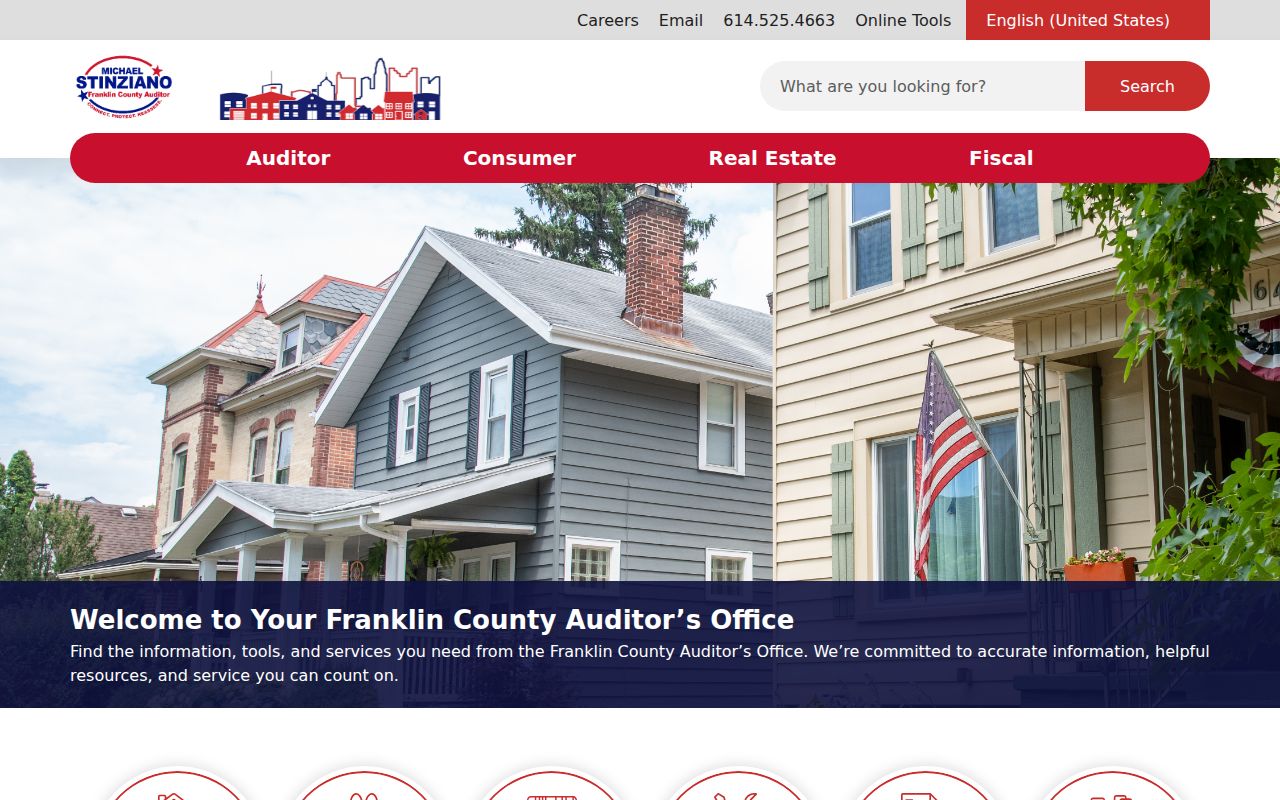
This Franklin County card is only a starting point for an Ohio parcel question. Every other Ohio county maintains its own property sites and fields.
- Situs address
- The physical location of the parcel.
- Tax mailing address
- The address where property notices are sent.
- Parcel
- A unit of land identified in the county tax and mapping system.
Ohio Voter Lookup Fields
The Ohio Secretary of State's Voter Lookup is an individual registration tool, not an all-resident directory. The live form is dynamic, and no stable set of input labels or required fields is published. Follow the labels and limits the current service shows.
| Search inputs | Dynamic labels; exact fields and required status were not exposed in the research capture. |
|---|---|
| Possible public result | Name, residence, county, precinct, and voting-history fields may be visible; the live result controls. |
| Restricted fields | Social Security and state ID numbers, phone, email, confidential records, and protected addresses are excluded. |
| Request alternative | For a broader voter file, contact the county Board of Elections and confirm fields, snapshot, cost, and redactions. |
Ohio keeps some voter-file fields off limits. Under Ohio Revised Code §3503.13, the public database excludes Social Security and driver-license numbers. It also excludes phone and email fields, confidential records, and protected addresses. So a residents directory built on voter rolls shows only the fields the official lookup displays. Stick to those.
For a correction, or a specific Ohio public-record question, contact the county Board of Elections. A broad Ohio voter-file request is a separate route. It comes with its own scope, cost, snapshot date, and redactions. It does not replace the standard resident lookup.
Ohio Court Searches Follow Jurisdiction
Ohio has no universal trial-court name search. Municipal, county, common pleas, and Probate Courts keep their own dockets. The case type decides which clerk to ask. The Supreme Court's county court directory helps route a reader to the right local Ohio court. It is not itself a statewide trial docket. Think of it as a map, not an index.
The Ohio Supreme Court's public docket covers Supreme Court matters, including appellate activity. A result there can show a case number, caption, filing or event dates, party role, disposition, and document links. The detail depends on the portal. The underlying trial file stays with the Ohio local court.
If a local portal leaves out an older case or image, call the clerk. Ask about its public terminal, records room, copy rules, or a request under Ohio's public-records law. One caution applies. Sealed, juvenile, adoption, victim, and protected personal information is not made open just because a docket entry appears online.
Ohio Vital Records Use Separate Custodians
Ohio vital records do not sit in one place. Birth and death records route through the Ohio Department of Health and local registrars. Marriage licenses and many estate records begin with an Ohio county Probate Court. Divorce material stays with the court that granted it. There is no statewide public marriage-record search. A certificate order is different from an open Ohio name index in any residents directory.
The ODH Bureau of Vital Statistics explains current state routes. Under ORC §3705.23, issuance depends on the record and applicable exceptions. Adoption or replaced birth records and medical-only fields carry special limits. A decedent's Social Security number is generally withheld for five years. An authorized requester may qualify for earlier access. Check the current ODH or local registrar form before ordering. Signature, eligibility, and fee details appear there.
Ohio libraries and archives can help locate historical evidence. They cannot issue a current certified certificate. A newspaper notice or obituary can point to an event. The registrar or court remains the source for an official copy.
Ohio Heir Searches Join Separate Records
An heir search shows why Ohio records work best as a sequence. Start with the county Probate Court's estate index. That is where the case, will, inventory, fiduciary appointment, land sale, or notice lives. Then use the Ohio Recorder's deed chain to tie a property transfer to the parcel. An obituary, city directory, cemetery entry, or family history file can bridge a name variant or relative. Each source has a different date and purpose.
Ohio birth, death, and marriage records may confirm a family event. The applicant must meet the current rules. Order a certificate only through ODH, an Ohio local registrar, or the Probate Court that holds it. Keep protected adoption or medical information out of an ordinary search. A family-history conclusion should name the Ohio records and dates that support it. It should not claim more than the sources show.
When a court file or land book is not online, ask the county office about options. These include a terminal, counter search, copy request, or archival transfer. The local Ohio library may also hold an obituary index, newspaper reel, directory, or county history. Any of these can supply the next name or date to check.
Request Ohio Resident Records
The Ohio Public Records Act, ORC §149.43, covers records kept by an Ohio public office. Exemptions and redactions still apply. A useful request names the office and the existing record series first. Then narrow the person, address or parcel, time span, and preferred format. Ohio law does not require an office to create a new report. It does not have to answer a research question.
A requester generally need not give a name or reason for an ordinary Ohio request. If a description is unclear, the office should explain how records are kept. It should also allow a chance to revise the description. Ask for non-exempt parts and the legal basis for any redaction. Prompt access is required. But there is no universal fixed number of days; large or complex searches depend on their scope and circumstances.
Work in order. Start with the online index. Then use an Ohio public terminal or records counter, and then a specific written request. The library or archive comes last for older material. The Ohio Attorney General's 2026 Sunshine Laws Manual is a current statewide reference. It covers request steps, exemptions, redactions, and remedies.
Ohio ZIP Codes Cross Political Lines
A postal city name is a delivery label rather than a legal boundary. One Ohio ZIP code can span several townships and municipalities. It may also cross school districts, tax districts, or even counties. An older Ohio residents directory may also list a village or township name. That name can differ from the preferred city on today's mailing address.
For a current address or city query, use the USPS ZIP Code Lookup. The Census Bureau's ZIP Code Tabulation Areas are statistical approximations. They are not a live USPS service map for Ohio. A county GIS may add its own ZIP layer, though sources and update dates vary. Treat the ZIP as a first filter. County, municipality, and parcel details then point to the right records office.
Compare postal results against an Ohio county parcel system. Do this before treating the delivery city as a boundary decision.
Ohio Protected Resident Addresses
Open records do not mean every Ohio field is public. The state's redaction law, ORC §149.45, shields personal details for designated public service workers. It also shields their home addresses. ORC §3503.13 goes further for voters. It excludes sensitive identifiers, certain contact fields, confidential records, and protected addresses. The Ohio Secretary of State's Safe at Home program offers qualifying participants a substitute address. It comes with mail-forwarding protection.
A missing address in a resident lookup may simply reflect one of these legal safeguards. Respect the gap rather than hunting for another list to get around it. Ohio public-records rules also work alongside federal driver-record limits. They also sit beside restrictions on adoption, juvenile, medical, tax, and education records.
When a field is redacted or missing, ask the custodian what public portion of the record remains available. Do not assume another source can lawfully supply information that the records office withholds.
Ohio Residents Directory Historical Sources
Ohio directory history lives in local collections, not one statewide database. The Ohio Genealogical Society inventory catalogs city, suburban, rural, and street-directory runs. Examples come from Akron, Ashland, and Springfield, with noted gaps in the years. The Toledo Lucas County Public Library digitizes a Directories category. It sits alongside Ohio maps, newspapers, cemetery records, and architecture material. A catalog search will confirm which Ohio title and years sit on the shelf. A quick word with library staff works just as well.
Treat any residents directory entry as a dated clue, not proof. A listing may lean on publisher abbreviations and head-of-household conventions. A city boundary may also have shifted since the edition appeared. Search the printed city and street form first. Then weigh the entry against census dates or a deed record. Do this before trusting it as current residence. For the full collection inventory and reading-room routes, see the city directory collections page.
Libraries, newspapers, and archives can bridge gaps where an online resident lookup stops. Note the collection name, edition year, page, and exact street line. Another family researcher can then retrace your path.